
Details
- TitleBooklet titled 'Decca Omnitrac Demonstrations in the Paris TMA'
- ReferenceUK0108 NAEST 310/01/04
- Date1963
- Creator
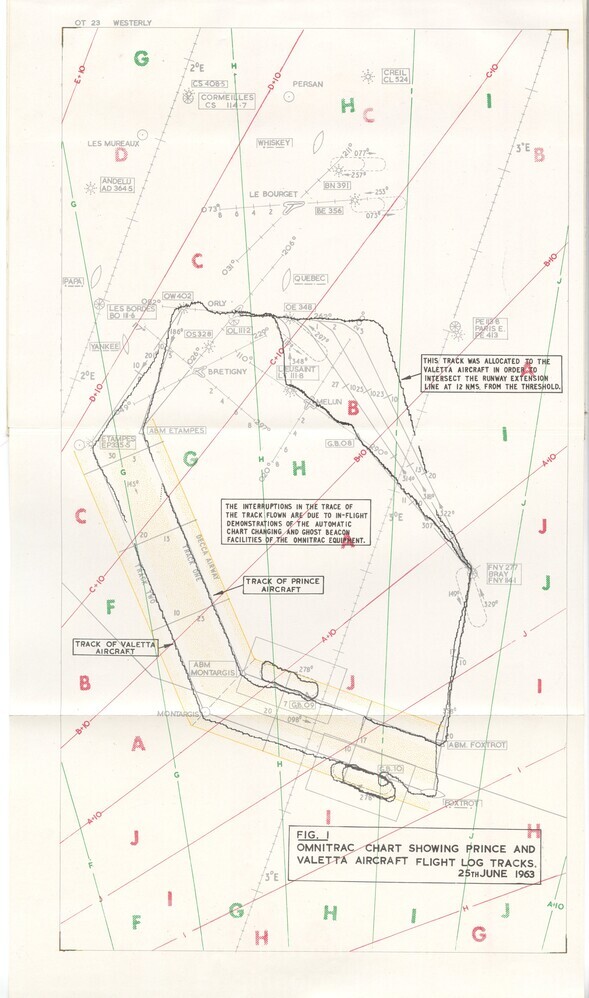
- Scope and ContentBooklet titled 'Decca Omnitrac Demonstrations in the Paris TMA.' Published by The Decca Navigator Company Ltd., London, England. 5-page booklet, with 4 fold-out figures. Cover signed 'M. J. Endacott.' Figures include: 1. Omnitrac chart showing Prince and Valetta aircraft flight log tracks. 25th June 1963. [digital image available] 2. Omnitrac chart showing Prince and Valetta aircraft flight log tracks. 27th June 1963. 3. Data link ground plot of the tracks flown by the Prince and Siebel aircraft. 27th June 1963. 4. Prince aircraft flight log track corresponding to the data link plot as shown in Fig.3
- Exent1 booklet
- Admin. history/BiographyAn engineer, William J O’Brien, had the idea of position fixing by means of phase comparison of continuous wave transmissions in the period 1936 to 1938. This wasn’t the first such system but O’Brien made some progress with it and undertook experiments in 1938 in California. Both the US Army and Navy considered O’Brien’s idea too complicated and the work ended in 1939. O’Brien was a friend of Harvey J Schwarz, Chief Engineer of the Decca Record Company in England and he sent details of the system to Schwarz in 1939 to put to the British military. Robert Watson-Watt reviewed the system, but did not follow it up considering it too easily jammed. However, in October 1941 the British Admiralty Signal Establishment (ASE) became interested in the system, which was then classified as Admiralty Outfit QM, and marine trials were conducted in 1942. Further trials were undertaken in April 1943 and January 1944 by which time the competing Gee system was known to the Admiralty. The two systems were tested head-to-head under the code names QM and QH. QM was found to have the better sea-level range and accuracy, which led to its adoption. 21 minesweepers and other vessels were fitted with Admiralty Outfit QM and on 5 June 1944, 17 of these ships used it to accurately navigate across the English Channel and to sweep the minefields in the planned areas. The swept areas were marked with buoys in preparation for the Normandy Landings. Decca Navigator Company Limited was formed in 1945 after the end of WWII as a subsidiary of Decca Records, and the system expanded rapidly, particularly in areas of British influence. Decca’s primary use was for ship navigation in coastal waters, offering better accuracy than the competing LORAN system. Post WWII fishing vessels were major users but it was also used on aircraft. At its peak Decca’s Navigator System was deployed in many of the world’s major shipping areas and more than 15,000 receiving sets were in use aboard ships in 1970.The system was employed extensively in the North Sea and was used by Helicopters operating to oil platforms. Decca Navigator was acquired by Racal in 1980 which then merged Decca’s radar assets with its own. As the patents on the original Decca technology expired in the 1980s, Decca suffered at the hands of competitors, and its income declined. Decca was eventually replaced, along with LORAN and other similar systems by GPS during the 1990s. The Decca system in Europe was shut down in the spring of 2000, and the last worldwide, in Japan, in 2001.
- Persons keyword
- Subject
- Level of descriptionItem

Hierarchy browser